 Adhorika Khan
The breakout ended weeks ago — so why is it still on your face? Because acne has a habit of leaving forwarding addresses. The good news: most of what people call “acne scars” are actually flat marks (red or brown discoloration) that fade substantially with the right routine and sun protection. True textured scars — pits and bumps — are permanent skin-structure changes that home care can soften only modestly; real revision belongs to a dermatologist.
That distinction — mark vs. scar — decides everything: the products worth buying, the timeline to expect, and when to stop scrubbing and book a professional. This guide walks through all of it honestly.
Key Takeaways
- Marks aren’t scars: red or brown flat spots (PIE/PIH) fade over months; pitted or raised texture is true scarring.
- Sunscreen is the #1 fading product — UV keeps re-tanning brown marks, undoing every serum you layer on top.
- The proven fading actives: retinoids, vitamin C, azelaic acid, and exfoliating acids — patience included, 8–12 weeks minimum.
- Pitted scars need procedures (microneedling, lasers, subcision, fillers) — creams cannot rebuild collagen valleys.
- The best scar treatment is preventing the next one: treat active acne and retire the picking habit.
What Are Acne Scars, Exactly?
When a pimple inflames, it damages the skin around it. How the skin rebuilds decides what’s left behind — and there are three very different outcomes wearing the same nickname.
Post-inflammatory erythema (PIE): flat pink-to-red marks — tiny damaged blood vessels near the surface, most visible on lighter skin tones. Post-inflammatory hyperpigmentation (PIH): flat tan-to-brown marks — excess melanin produced during the inflammation, more common and longer-lasting on medium and deeper skin tones. True scars: texture change — the skin healed with too little collagen (depressed “pitted” scars) or too much (raised scars, more common on jaw, chest, and back).
Run a finger over the area with your eyes closed. Feel nothing but see color? You have marks — and genuinely good news ahead. Feel dips or bumps? That’s structural, and the honest playbook is different.
Why Does That Difference Matter So Much?
Because marks are a pigment-and-blood-vessel problem — chemistry that creams can influence — while pits are an architecture problem. No serum, however expensive, refills a collagen valley. The beauty aisle quietly profits from blurring this line; your budget shouldn’t.
How Long Do Acne Marks Take to Fade?
Untreated, red marks (PIE) typically fade over a few weeks to several months. Brown marks (PIH) are slower — months to a year or more, especially on deeper skin tones, and every unprotected sun exposure resets the clock backwards. A consistent routine roughly halves these timelines; nothing legitimate erases them in a weekend.
Set the expectation honestly: photograph your face in the same light once a month. Fading is real but too gradual to see day-to-day — the monthly photos are where the motivation lives.
The Non-Negotiable First Step: Sunscreen
If you do only one thing from this article, make it this. UV exposure stimulates melanin in exactly the spots already over-producing it — every bare-faced sunny errand re-darkens your brown marks and reddens your red ones. Daily SPF 30+ isn’t the boring option; it is, by a wide margin, the most effective fading product you can buy, because it stops the un-fading. Our complete SPF guide covers choosing one you’ll actually wear every day.
Which Ingredients Actually Fade Marks?
Retinoids: The Workhorse
Adapalene (available over the counter), retinol, and prescription tretinoin accelerate cell turnover — literally speeding up the replacement of pigmented cells — while building collagen that modestly improves shallow texture over time. Start low, go slow, and expect the full story to take three months. Our retinol guide covers the on-ramp without the irritation.
Vitamin C: The Brightener
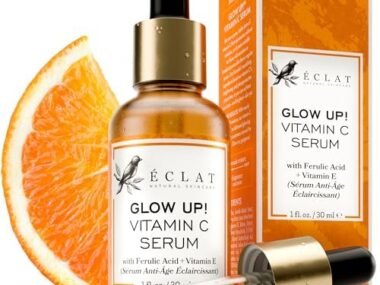
A morning vitamin C serum inhibits the enzyme melanin production depends on, fading brown marks while adding antioxidant backup to your sunscreen. It pairs with SPF like coffee pairs with morning — details in our vitamin C guide.
Azelaic Acid: The Underrated Multitasker
Gentle enough for sensitive skin, effective on both PIH and lingering redness, and it fights the acne itself while fading its leftovers. If your skin argues with retinoids, azelaic acid is the diplomatic answer.
Exfoliating Acids: The Surface Crew
Glycolic (AHA) lifts pigmented surface cells; salicylic (BHA) keeps pores clear so new breakouts don’t restock the marks. Two to three nights a week is plenty — the AHA vs BHA guide explains which fits your skin. Over-exfoliating inflames, and inflammation is the villain of this entire story.
Niacinamide: The Supporting Player
It interrupts pigment transfer between cells and calms the redness-prone — a gentle daily teammate rather than a solo hero.
A Realistic Routine for Fading Marks
Morning: gentle cleanse → vitamin C serum → moisturizer → SPF 30+ (the step that makes the others count). Night: cleanse → retinoid or azelaic acid (alternate with an acid night twice a week if your skin tolerates it) → moisturizer.
That’s it. Six products, no devices, no 14-step choreography. Give it twelve weeks before judging — and if a new product stings, swells, or peels you raw, that irritation is manufacturing the next round of marks. Layering rules live in our ingredient dictionary.
What Actually Works on Pitted Scars?
Honesty first: home care improves pitted scars maybe 10–20% at best (retinoids, months of them, on shallow scars). Real revision is procedural, and it works by re-injuring the scar on purpose so it heals better:
Microneedling — controlled micro-punctures trigger fresh collagen; several sessions, modest downtime, solid evidence, works across skin tones. Laser resurfacing — more dramatic remodeling with more downtime; tone-dependent (some lasers risk pigment issues on deeper skin — choose a dermatologist experienced with your skin tone). Subcision — a needle releases the fibrous tethers pulling rolling scars down; often paired with other treatments. TCA CROSS — high-strength acid dotted into individual ice-pick scars. Fillers — instant lifting of depressed scars; temporary but gratifying.
Expect “significant improvement,” not “deleted” — a good dermatologist will say exactly that in the consultation, and combination plans beat single-treatment promises.
What About At-Home Dermarolling?
Store-bought rollers sit in an awkward middle: needles long enough to matter carry infection and scarring risk at home; needles short enough to be safe mostly boost serum absorption. If textured scars bother you enough to consider needles, that budget is better spent on professional microneedling — sterile, correct depth, actual results. (The derma roller options exist for the committed; go in with honest expectations and fanatical hygiene.)

The Habits That Sabotage Fading
Picking and squeezing converts two-week pimples into two-year marks — every pick multiplies inflammation, and inflammation multiplies pigment. Hands off is a genuine treatment. Skipping SPF on cloudy days (UVA doesn’t take weather off). Rotating new products every two weeks — nothing gets its twelve-week trial, and each switch risks fresh irritation. Scrubbing marks with gritty exfoliants — you cannot sand off pigment that lives deeper than the scrub reaches, but you can inflame it darker. Lemon juice and toothpaste folklore — both irritate, and irritation pigments; the internet owes millions of faces an apology.
Does Fading Differ by Skin Tone?
Yes, meaningfully. Deeper skin tones produce melanin more readily, so PIH runs darker and lingers longer — which makes daily SPF and gentle (never aggressive) actives even more important, and makes azelaic acid and niacinamide particularly good allies. For procedures, choose providers experienced with melanin-rich skin: the wrong laser setting can trade a scar for a pigment patch. Fitzpatrick-aware care isn’t a luxury; it’s the standard to insist on.
Prevention: The Cheapest Scar Treatment Ever Invented
Every scar starts as an untreated or over-handled breakout. Treating active acne early — consistently, not just on bad-skin days — is scar prevention in real time. If breakouts are still arriving faster than marks can fade, work both ends: our guides to blackheads and purging vs breaking out cover the acne side, and a well-chosen acne treatment serum closes the faucet while everything above drains the tub.

When Should You See a Dermatologist?
Book the appointment when: texture bothers you (pits and bumps are procedure territory from day one), marks haven’t budged after four to six months of honest routine, acne is still actively scarring despite treatment (prescription acne control prevents compounding damage), or any “scar” changes shape, itches, or grows — raised scars that keep growing (keloids) have their own treatment path, and anything atypical deserves professional eyes. A dermatologist visit isn’t the failure ending; for textured scars it was always the real plan.
Your 90-Day Fading Plan
Week 1: take baseline photos; start SPF daily + gentle cleanse + moisturize. Weeks 2–3: add vitamin C mornings. Week 4: add the retinoid two nights weekly, building slowly. Weeks 6–12: steady state — the boring middle where results quietly assemble. Day 90: compare photos. Meaningful fading → continue. Texture unchanged and bothering you → that’s your dermatologist consultation, booked with clear eyes and realistic questions.
Covering Marks With Makeup (Without Feeding the Cycle)
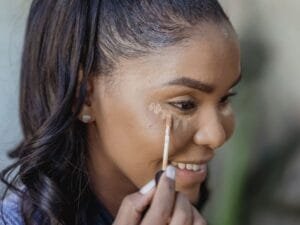
Fading takes months; life happens weekly. Good coverage is a legitimate part of the plan, done right: a non-comedogenic base, color-correcting logic (peach or orange correctors neutralize brown marks on medium-deep tones; green calms red on lighter tones), then concealer only where needed rather than a full-face mask.
Two rules keep makeup from prolonging what it hides: apply with clean tools or fingers (a foundation brush that hasn’t been washed in a month is re-seeding your cheeks nightly), and remove it completely every night — gently, since aggressive wiping inflames the exact spots you’re fading.
SPF still goes underneath. Most makeup’s listed SPF is applied too thinly to deliver its number; the dedicated sunscreen layer is the one doing the work.
Do Scar Patches and Silicone Sheets Work?
Worth sorting, because they solve different problems. Hydrocolloid pimple patches are prevention tools: they cover an active spot, absorb fluid, and — their greatest gift — physically block picking. Used on a healing blemish, they genuinely reduce the odds of a mark worth an article like this one.
Silicone sheets and gels have real evidence for raised scars — surgical and keloid-type scarring on body skin — where months of consistent wear flattens and softens. For flat facial acne marks they offer little; for the rare raised acne scar on jaw, chest, or shoulder, they’re a legitimate, dermatologist-endorsed home option.
Microneedle patches promising scar revision at home occupy the gap between those two: minimal evidence, minimal risk, minimal expectation.
The Part Nobody Puts in the Routine: Perspective
A note that belongs in every scar article and rarely makes it: the mirror at ten centimeters is not how anyone sees you. Marks that dominate your morning inspection are genuinely invisible at conversation distance — and the fading you’ll dismiss as “too slow” will be obvious to anyone who hasn’t seen you in two months.
Run the routine, take the monthly photos, book the dermatologist for the texture that truly bothers you — and let the rest be skin that lived through something. Perfect was never the clinical endpoint; comfortable is.
The honest toolkit, if you’re building from scratch:
The honest fading toolkit:
Frequently Asked Questions
Do acne scars go away on their own?
Flat red and brown marks fade naturally over weeks to many months, faster with sunscreen and actives. True textured scars — pits and raised bumps — are permanent without professional treatment, though they soften slightly over years.
What fades acne marks the fastest?
Daily sunscreen plus a retinoid at night and vitamin C in the morning is the best-evidenced combination. Expect visible change in eight to twelve weeks — anything promising overnight results is marketing, not dermatology.
Can retinol remove pitted acne scars?
No. Retinoids modestly improve shallow texture over months and help prevent new scarring, but they cannot rebuild the collagen structure of pitted scars. Microneedling, lasers, subcision, and fillers are the treatments that address pits.
Why do my acne marks look darker after the sun?
UV stimulates the exact melanin-producing cells that are already overactive in those spots, re-darkening them with every exposure. This is why dermatologists call sunscreen the most important scar-fading product.
Is microneedling worth it for acne scars?
For rolling and shallow boxcar scars, professional microneedling has solid evidence — expect meaningful improvement over several sessions, not perfection. It’s also one of the safer options across all skin tones.
How do I stop getting new acne scars?
Treat active breakouts early and consistently, and stop picking — squeezing multiplies inflammation, and inflammation is what creates both pigment marks and true scars.
Does drinking water or diet fade acne scars?
Hydration and balanced eating support skin health generally, but no food or water intake fades existing marks. The levers that move scars are sun protection, proven topicals, time, and professional procedures.

 Adhorika Khan